


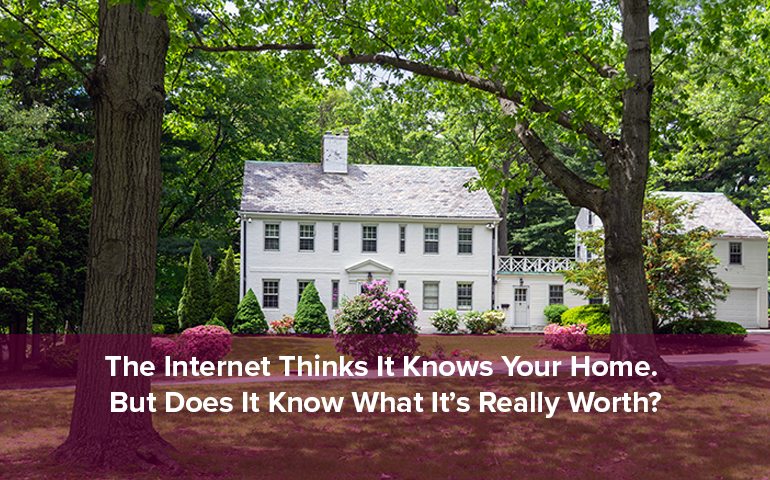
The Internet Thinks It Knows Your Home. But Does It Know What It’s Really Worth?
Somewhere on the internet, there's a version of your home that has never hosted a holiday dinner, survived a kitchen renovation, or watched your kids grow up. It knows your square footage. It probably knows how many bedrooms you have. It may even know what you paid for the property. And yet, this digital version of your house has an opinion about what it's worth. Welcome to the fascinating world of online home value estimates, where powerful technology can put a number on your property in seconds. The question isn't whether that number is useful. It absolutely can be. The more interesting question is: What happens when the home an algorithm sees isn't quite the home you actually own? Picture this. You've spent the last seven years turning your house into something special. The dated kitchen is gone. The basement is finished. You've replaced the windows, upgraded the landscaping, and finally created that outdoor space you've always wanted. Your home has changed dramatically. But somewhere in a database, parts of it may still look like they did seven years ago. That's because online home valuation tools work with information they can access. They analyze property records, previous sales, comparable homes, and market data to generate an estimated value. They're remarkably convenient, and they can provide useful insight into the housing market. But they don't necessarily know about the custom cabinetry you installed last spring. They haven't stood in your living room and noticed the natural light pouring through those oversized windows. And they can't tell whether the house next door sold for less because it needed substantial repairs. The internet knows a lot about your address. It doesn't always know your home. That's where the story gets interesting. Imagine two homes listed for sale in the same neighborhood. Both have four bedrooms. Both offer approximately 2,200 square feet. Both sit on similar lots. An automated valuation might place them in roughly the same price range. But one has a beautifully updated kitchen, a functional floor plan, and a backyard that feels like a private retreat. The other needs new flooring, has an awkward layout, and hasn't seen a meaningful update in decades. Would buyers view them as equally valuable? Probably not. And here's the twist: Even the homeowner who invested heavily in improvements can't assume every dollar spent will translate into an equal increase in market value. A $30,000 renovation doesn't automatically add $30,000 to the selling price. The real question is how buyers in that particular market respond to those improvements. A local real estate professional can evaluate comparable sales, current competition, property condition, and buyer preferences to help answer that question. An algorithm can calculate patterns. An experienced agent can interpret what those patterns mean for your particular home. Before we give the humans all the credit, let's acknowledge something important. Online valuation tools can be genuinely eye-opening. Homeowners often develop their own ideas about what their properties are worth. Those ideas might come from a neighbor's recent sale, a renovation project, or simply the price they remember paying years ago. But the housing market doesn't stand still. An online home value estimate can introduce information you haven't considered. Maybe nearby properties have appreciated more than you realized. Perhaps recent sales suggest the market is behaving differently than you expected. Even when an estimate isn't perfectly accurate, it can spark the right questions. And sometimes, the most valuable part of an estimate isn't the number itself. It's the curiosity that follows. Wondering what the digital version of your home thinks it's worth? Take a look with our online home value estimator. You might be surprised by what you discover. Here's where homeowners can get caught in an unnecessary debate. Which website has the most accurate estimate? Which number should you trust? Why does one platform suggest your home is worth more than another? It's tempting to treat home value estimates like competing contestants on a game show, with one number eventually declared the winner. But that's not really how real estate works. Different valuation systems may use different data, calculations, and assumptions. It's entirely possible for two platforms to produce different estimates for the same address. Neither number is a promise. And neither number is a substitute for understanding what a buyer might realistically pay. The better approach is to view automated estimates as one piece of a much larger puzzle. A real estate agent can add the missing pieces through a comparative market analysis, an evaluation of your home's characteristics, and knowledge of current local activity. The goal isn't to prove the computer wrong. It's to understand the property more completely. Consider how differently two buyers might experience the exact same home. One walks through the front door and immediately notices the spacious kitchen, imagining weekend breakfasts and family gatherings. Another sees the same kitchen but focuses on the home's proximity to work and the convenience of a first-floor bedroom. A third buyer might love the property but hesitate because the backyard requires more maintenance than they're willing to handle. None of those reactions appears neatly in a property database. Yet buyer preferences can influence interest, competition, and ultimately the offers a home receives. This is particularly relevant in markets throughout Western Pennsylvania and Northeast Ohio, where properties can vary widely in age, architecture, lot characteristics, and neighborhood appeal. A beautifully maintained century-old home may attract buyers for entirely different reasons than a newer property with an open floor plan. An online estimate offers a numerical perspective. A real estate professional helps connect that number to the people who may actually purchase the property. Here's a better way to think about it. Trust it to be a starting point. Trust it to introduce you to information worth exploring. Trust it to help you become more curious about your home's potential value. But don't expect it to know everything. Use the estimate to begin a conversation, not end one. Because when you're making a decision involving one of your largest financial assets, having more than one perspective isn't a complication. It's an advantage. The tool may not have complete information about renovations, upgrades, or your property's distinctive features. It may also be using comparable sales that don't fully reflect your home's condition. Yes. Automated estimates can overestimate or underestimate a property's market value. The price buyers are willing to pay depends on factors such as condition, competition, financing, and current demand. Yes. An agent can evaluate your home's condition, consider improvements, review competing properties, and explain how local buyer activity may influence its potential selling price. Definitely. Understanding your property's estimated value can be helpful when considering future renovations, downsizing, relocating, or simply keeping track of your homeownership investment. Start with an online estimate, then speak with a local real estate professional who can provide a comparative market analysis and help explain the factors influencing your property's value. Your home has two stories: the one told by public records and market data, and the one revealed by its condition, character, improvements, and place in the neighborhood. Both stories matter. At Berkshire Hathaway HomeServices Stouffer Realty, we believe the most useful real estate technology doesn't replace personal expertise. It makes that expertise even more valuable by giving homeowners a smarter place to begin. So go ahead. See what the algorithm thinks. Get curious. Ask questions. Then let a knowledgeable local real estate professional help you understand the story behind the number. Discover Your Home's Estimated Value and connect with Berkshire Hathaway HomeServices Stouffer Realty to explore what your home could be worth beyond the screen.

Meet the House the Internet Thinks You Live In

The $30,000 Question: What Does a Buyer Actually See?

Plot Twist: Sometimes the Algorithm Knows Something You Don't

The Zestimate Isn't Your Competition. Neither Is Any Other Algorithm.
What Your House Is Worth Depends on Who's Looking

So, Should You Trust Your Online Home Value Estimate?
Frequently Asked Questions
Why does my online home estimate seem too low?
Could an online estimate be higher than my actual selling price?
Can a real estate agent tell me something an online estimate can't?
Is there any reason to check my home's value if I'm not selling?
What's the best way to get a clearer picture of my home's value?
Your Home Deserves More Than a Guess. Give It a Second Opinion.
